
Heated Rivalry Is Everywhere. A Dating App Still Wouldn’t Work for Those Guys.
October 21, 2026 · 7 min read · By the Kin team
Heated Rivalry did not stay a niche hockey romance. Rachel Reid’s story about Shane Hollander and Ilya Rozanov — rival stars who spend years hiding what they are to each other — became one of the shows people actually talked about, on Crave and HBO Max, and then everywhere else. Season 2 is already on the way. The heat is real. So is the problem underneath it.
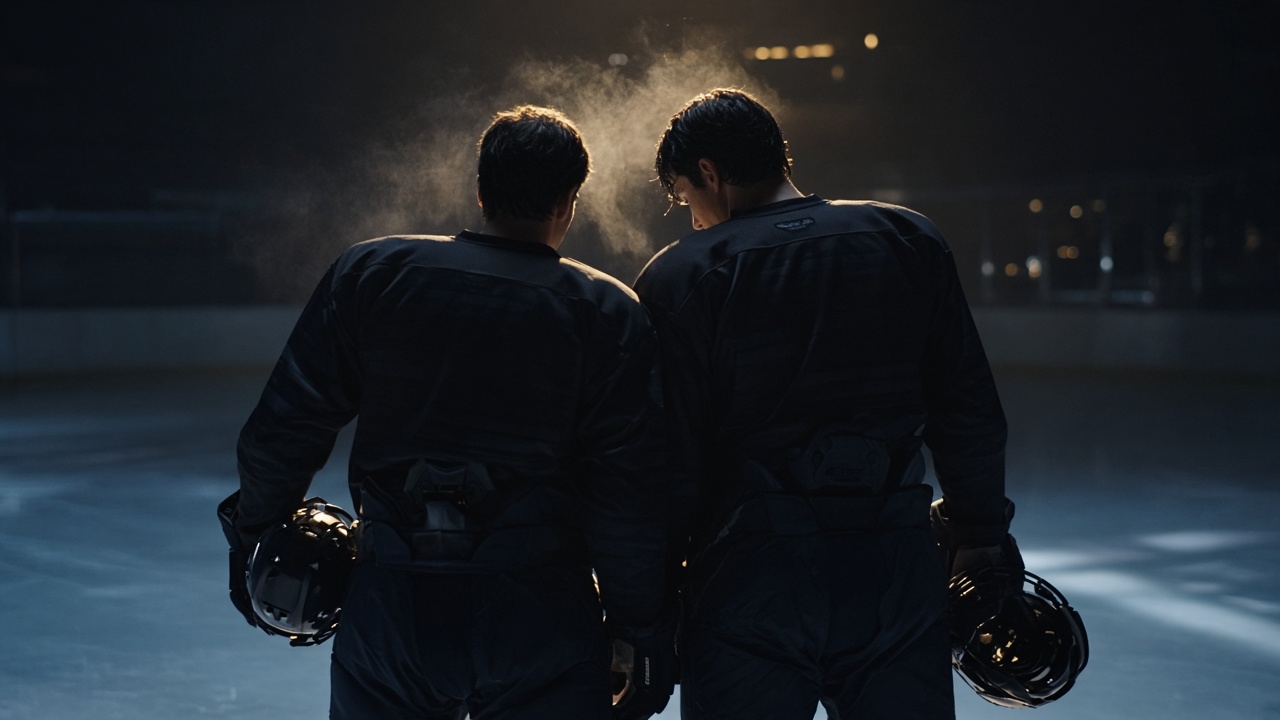
Shane and Ilya are not struggling to find chemistry. They are struggling to have a life that the sport, the cameras, and their own rivalry will allow. What starts as a secret between two rookies stretches across years of denial, distance, and the simple fact that two of the biggest names in the league cannot be ordinary about who they love. The show is fiction. The trap is not.
A famous athlete doesn’t get to come out casually
Hockey still treats queerness as a disruption. A captain’s girlfriend is content. A captain’s boyfriend is a press conference. Sponsors, teammates, family, the opposing bench, the comments under every highlight — all of it arrives the moment a sports star stops being theoretically straight. Plenty of players stay quiet not because they are confused, but because the cost of being known is their job, their room, and their name.
That is Shane and Ilya’s bind, and it is the bind of a lot of real men who are nowhere near a novel: visible enough that a stranger could recognize them, not safe enough to let that stranger know. Fame just turns the volume up. You do not need to be on HBO for a coworker, a client, or a group chat to make coming out feel like a career event.
Dating apps don’t solve the privacy problem. They are the privacy problem.

The usual advice — make a discreet profile, crop your face, turn off location — collapses the moment your face is already public, or even just familiar inside one company, one league, one city. Apps are built to be found. Nearby. Mutual friends. A screenshot that travels faster than you can delete the account. For a man whose entire value is being recognized, a grid is not a dating tool. It is a leak.
There is a second failure, quieter than the outing risk. Apps are bad at the person these guys actually need: someone who can live with secrecy for a while, who wants a relationship rather than a story, who will not treat a famous or careful man like a conquest. Photos and a few lines of chat cannot carry that. They mostly carry looks, proximity, and whoever is online at midnight.
What men in that spot actually do
When being browsable is unsafe, people stop browsing. Friends introduce friends, until the circle is too small and too close to the team, the office, the family. Or they look for a matchmaker — someone who already knows the constraint, screens for intent, and only makes an introduction when both people could actually survive each other’s lives.
That is not a luxury version of Grindr. It is the only format that treats privacy as the product. You are not performing for a feed. You are not hoping a filter hides you from the person in the next stall. Someone who understands what you need goes and looks, then brings back one person.

Kin is built for that kind of discretion
Kin is private matchmaking for gay men who want a serious relationship and cannot afford a public profile. You are not on a map. You are not a face in a grid that teammates, clients, or strangers can scroll. An application is reviewed before anyone is in the pool. Kin uses AI to learn who you are and who you’re actually looking for — pace of life, values, how out you can be, what “serious” means to you — and searches a verified network for a fit. You meet one person at a time. Names and faces stay private until you both say yes.
- No public profile, so dating never becomes something coworkers can stumble into.
- Matching weighs intent and compatibility, not who photographed best under locker-room lighting.
- One introduction at a time, so you are not managing a secret across five chats.
- Identity unlocks only when the interest is mutual.
Shane and Ilya get a cottage and a decade of almost. Most men don’t get a writers’ room. They get a phone they keep turning face-down. If that is the part of the show that felt familiar, skip another app.
See how Kin keeps you private and how an introduction actually works. When you want a match that doesn’t require you to be searchable, apply to Kin. Joining is free.